

What Is Yoga? The True Meaning of Citta Vritti Nirodha: Yoga Sutra 1.2

Introduction: Moving Beyond the Physical Posture
When most people in the modern world hear the word yoga, they picture flexible bodies performing complex postures (āsanas) on a rubber mat. Yet in the foundational classical treatise on yoga—the Yoga Sūtras compiled by Sage Patañjali over two thousand years ago—only three of the 196 aphorisms even mention physical posture.
In the second verse of Chapter 1, Patañjali delivers the master definition that anchors the entire science of yoga:
|| योगश्चित्तवृत्तिनिरोधः ||
(Yogaś citta-vṛtti-nirodhaḥ)
To truly understand yoga, one must unpack these four Sanskrit words not as abstract dogma, but as an exact manual for human consciousness.
Word-by-Word Sanskrit Breakdown (IAST)
Sanskrit Term | IAST Transliteration | Literal Meaning | Yogic Significance |
|---|---|---|---|
**योगः** | *Yogaḥ* | Union, integration, yoke | The state of unified, undisturbed awareness. |
**चित्त** | *Citta* | Mind-stuff, consciousness | The totality of mind: intellect (*buddhi*), ego (*ahaṅkāra*), and sensory processing (*manas*). |
**वृत्ति** | *Vṛtti* | Whirlpools, waves, modifications | The constant thoughts, desires, fears, and memories rippling across the mind. |
**निरोधः** | *Nirodhaḥ* | Stilling, cessation, channelization | The settling or restraint of mental waves so the underlying stillness emerges. |
The 5 States of Mind (Citta Bhūmis)
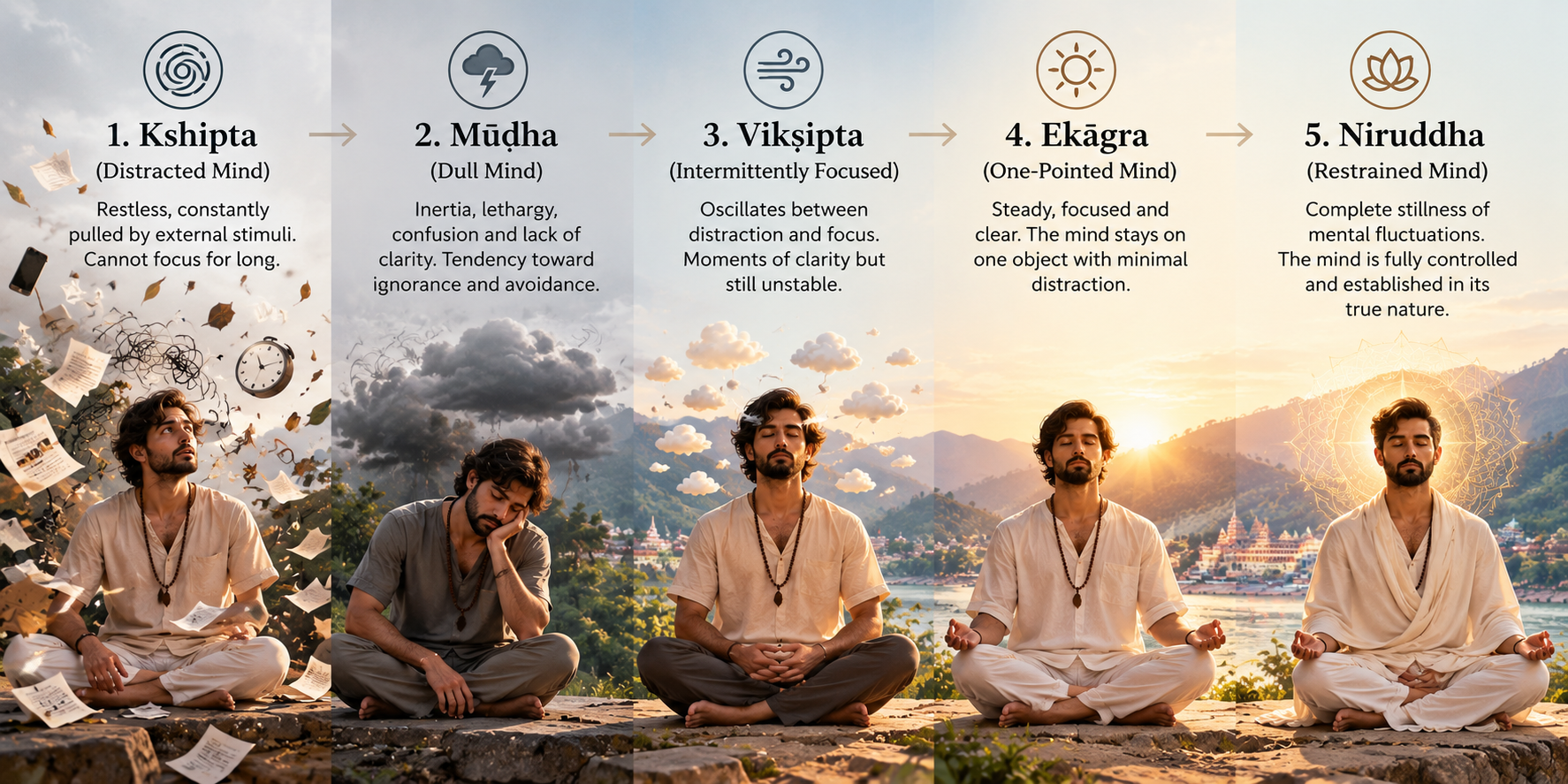
Classical commentators such as Sage Vyāsa explain that human consciousness moves through five distinct developmental stages:
• Kṣipta (Scattered / Restless):: The hyperactive mind jumping erratically between desires, worries, and notifications.
• Mūḍha (Dull / Lethargic):: The heavy, lethargic state clouded by laziness, sleepiness, or depression (*Tamas*).
• Vikṣipta (Partially Focused):: The ordinary state where the mind concentrates for brief moments before getting distracted again.
• Ekāgra (One-Pointed):: Deep, uninterrupted concentration (*Dhāraṇā*) where attention remains fixed on a single focus.
• Niruddha (Fully Stilled):: The ultimate state of absorption (*Samādhi*) where mental modifications cease entirely, revealing pure consciousness.
The Metaphor of the Mountain Lake
Imagine standing on the bank of a pristine Himalayan lake in Rishikesh. If the wind creates turbulent waves, or if someone throws mud into the water, you cannot see the precious gems resting on the lake bed.
• The water is your Citta (mind-stuff).
• The wind and waves are your Vṛttis (thoughts and emotional turbulence).
• The lake bed is your Ātman or Draṣṭā (the True Seer / Authentic Self).
When the wind stops blowing and the mud settles, the water becomes crystalline. You do not create the bottom of the lake; it was always there. In the same way, Nirodha does not destroy your mind—it simply allows the turbulence to settle so your true nature becomes visible (Sūtra 1.3: Tadā draṣṭuḥ svarūpe 'vasthānam).
60-Second Micro-Drill: Experiencing Citta Vritti
You do not need to sit in a cave to observe Citta Vṛtti. Try this right now:
• Close your eyes and take three slow, smooth breaths.
• For the next 30 seconds, watch your mind as if you were sitting in a cinema watching a screen.
• Notice the thoughts that arise: an image, a memory of yesterday, an itch, or a plan for dinner.
• Do not fight or judge the thoughts. Simply whisper internally: "I am the observer of this wave."
• Notice the brief gap of silence between one thought ending and the next thought beginning. That gap is a glimpse of Nirodha.
Frequently Asked Questions
Q1. Can beginners do this practice daily?
Q2. What is the best time to practise?
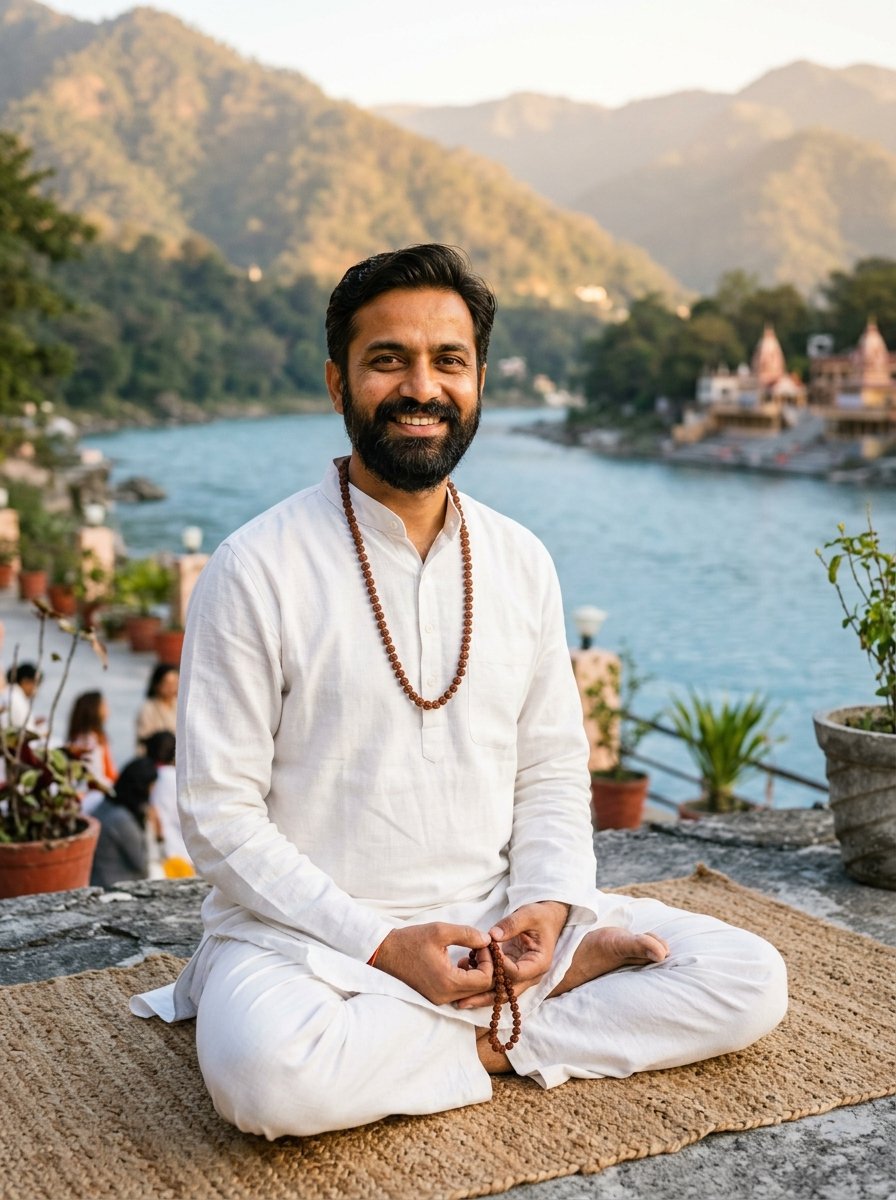
Siddhant School of Yoga
Yoga Master & Ashram Guide
Dedicated to sharing traditional yogic sadhana, Vedic philosophy, and authentic Himalayan spiritual practices at Siddhant School of Yoga in Rishikesh, India.